The sorta down side was that there had been lots of settling under the wood pile supports, making it somewhat unsafe being aboard. Good or bad, I did get a chance to climb up to have a look around in the engine room - before I discovered the settling issue. Unfortunately, I was unable to do my final measuring for the replacement waste-water replacement holding tank. Next weekend I will do that, for sure, as the marina contacted me today to confirm that they have shimmed the blocking to make in once again safe to board the boat.
Inspiring Boating Stories & Travel fun from the Great Lakes and beyond!
Along with travel posts, I also share boat repairs and upgrades, tips and hints.
* Disclosure: As an Amazon Associate I earn from qualifying purchases via links.
Tuesday, April 1, 2014
Spring Thaw - Finally!!
The sorta down side was that there had been lots of settling under the wood pile supports, making it somewhat unsafe being aboard. Good or bad, I did get a chance to climb up to have a look around in the engine room - before I discovered the settling issue. Unfortunately, I was unable to do my final measuring for the replacement waste-water replacement holding tank. Next weekend I will do that, for sure, as the marina contacted me today to confirm that they have shimmed the blocking to make in once again safe to board the boat.
Saturday, January 11, 2014
$18 Billion to Keep Asian Carp Out? I Got a Better Idea!
The report goes on to say that beyond the huge amount of money - and you know that figure will only increase - it will take decades to implement. There has already been reports of Asian Carp DNA being discovered in the Great Lakes (Article). And those guys expect to that they won't spread from there in the decades they need to stop the fish from getting in? Like I said, good luck.
The Army Corp already built an electrified fence just outside of Chicago on a river that connects Lake Michigan with the Mississippi River (the source of these pesky critters), back in 2002. The theory behind that is a small electrical current is introduced in the water, stopping the fish from swimming through. The trade-off is that private boats traversing this spot - including those doing the 'Great Loop' trip - are forced to stop ahead of it, get out and be towed across the electrified portion, at a cost of $600 per tow.
There is already litigation between the border States to have Michigan dam off the waterway in an attempt to stop the carp. So the fun has already begun. I'm sure the Corp's cost estimation didn't take into account the lawyers' fees both now and in the future.
I guess nobody ever thought of installing a marine railway, like we have on the Trent Severn Waterway?? The original 'Big Chute Marine Railway' was built in the early 1900's to get boats over a steep vertical change in elevation on the Severn River and was slated to be replaced with a conventional lock in the 1960's. Right around that same time, there was a scare with another invasive species, that of the Sea Lamprey eel. Those little buggers stuck to the bottom of boats and it was determined that they didn't survive long if the boat they were hitching a ride on was hauled out of the water.
So, rather than getting rid of the marine railway, it was decided to build a new, larger one that could accommodate a number of boats at one time. This 'new' carriage has been in service since 1977 and has kept the Lamprey at bay. I'm sure that a similar, more grander version could be installed at Chicago - at both a significantly lower cost and quicker timeline.
![]() |
| Big Chute Marine Railway at Ontario's Trent Severn Waterway |
Thursday, January 9, 2014
2,700 Horsepower Go-Fast Boat at SEMA Show
All of this vast gathering comes together to showcase the newest and best in the automotive world. Think SEMA and think cars.
This year, there was at least one display that was turning heads and it wasn’t on four wheels. In fact, it was on its side! Yes, the car guys and gear heads got to ogle an impressive assembly of technology, all sitting pretty in the hull of a boat. In fact, that very hull was an impressive bit of technology all on its own. And we haven’t even gotten to the combined 2,700 horsepower neatly tucked away in the engine bay.
So, to understand why a big, 41 foot boat was front and center in the bastion of automotive wonder, we gotta look at the formidable drivelines on this thing. And the best part is that it’s got two of ‘em.
Oh, did I just hear muted whimpering from some of the car guys out there? Well, fear not, because these same engines are going to be available for your car, but you’ll probably only need one at a time.
First, let’s have a quick look at that hull. Composed using a 100%, full epoxy infused technology via the use of vacuum bagging, the process allows for the epoxy to be formed over the gel coat without possible air bubbles being entrapped during the build - a potential problem with a traditional hand layup. Carbon and Kevlar are also introduced in the running surfaces, areas that will take the greatest punishment when it’s go time.
A Lot of Horses
Scuttlebutt at the SEMA show was that this boat could touch 200 MPH. That’s fast in anything, but to do it on water takes a little more ‘Oomph’. Remember that not only are we having to push the weight of the boat and crew, but overcome the friction of the water. Sure, the catamaran hull design helps in that department by reducing the surface area of the boat coming in contact with the water, but we still got to get it moving forward in the first place. The same precept used to get the most speed out of cars holds true with boats. Throw in more horsepower.
Horsepower is why Mercury Marine chose the 50th SEMA show as the venue to unveil their new power plants. Shy of having even more of the aforementioned models standing around one of their engines, they were able to create quite a stir by partnering with Dave’s Custom Boats and this beautiful boat. Dave’s is no stranger to go-fast boats, having produced state of the art performance boats for two decades.
The twin 1350 HP engines push power through M8 drives, designed to handle the immense torque of the motors. The Mercury Racing QC4v engine designation is derived from the in house designed, quad cam, four-valve, turbocharged setup.
Also part of the display was an exotic car, sporting the 1650 crate engine, the 9-Litre V-8 sharing the same aspects as its marine incarnation. Unlike the M-41, I’m sure just the one engine will be enough.
A New Approach
The unveiling of this line of performance engines coincides with the recent announcement by Mercury Marine that they will be building their own gasoline engines for their MerCruiser stern drives and Zeus pod drives. This was a big step for the company, when considering that they had been getting their power plants from GM (+ Ford in earlier years) and merely ‘marinizing’ them. No longer will they be simply applying their own exhaust and cooling systems, painting them black and shipping to the boat manufacturers. Instead, Mercury will acquire bare block cores from out sourced manufacturers (most likely GM) and fitting them out with their own technology.
This is a bold move for Mercury, who has been around since 1939, a move motivated by the increasingly rapid makeovers in the corresponding automotive engines. Engine technology is evolving at a quicker and quicker pace and car builders are forced by competition to embrace it, leading to engine production cycles being ever shortened. To maintain a longer term grasp over their marine engine designs, Mercury felt they will be better served by providing their own, steady supply to the end users – boaters & repair facilities – as well as their mainstay, that of the boat manufacturers.
Old is New Again
This foray into the automotive world isn’t a first for Mercury Marine. Its founder, Carl Kiekhaefer, was an influential force in NASCAR, having won 80% of the races he entered from 1955 to 1957, capturing three national championships. His innovations in the sport are still with us today. These include ‘firsts’ such as his crew being the first to wear matching uniforms and practice pit stops. His team was also the first to transport their cars with enclosed haulers, emblazoned with team colours, of course. Amongst his technical innovations were pleated paper air filters and wide base rims, originating in his road racing R&D efforts.
Move forward to 1990, when Mercury Marine was tapped by General Motors produce the all-aluminum, 350 cubic inch LT-5 engine for the new Corvette ZR-1. GM approached Mercury as they had already developed the expertise in design and manufacturing of their aluminum marine engines. Taking the concept one step further, Mercury Racing took an LT-5, modified it for marine use and put it a Baja 223 sport boat (Baja was a manufacturer owned by Brunswick, the parent company of Mercury Marine).
The boat was paired with a similarly powered 1990 Corvette and the duo was known as the ‘Wette Vette’ project, touring the country, creating its own stir. So it looks like the show at SEMA was a revisit of a tried and true marketing concept, with the big difference being the incredible advancements in technology for both boat and motor that has happened in the ensuing years.
Package Deal
As with anything, time and talent leads to better, faster and safer products. When it comes to a prestige boat like the M-41, there is a sense that Dave’s Custom Boats has realized their goal to ‘Build the Best’. By merging state of the art technology with a refined look not commonly seen on go fast boats, the combined talents at Dave’s and Mercury Racing have produced an end product that is sure to turn heads well beyond SEMA.
So, if you think that all this power, technology and killer good looks would be a nice addition to your collection, it can be had as a package – boat, custom trailer and hauler – for 1.25 million USD. Sure, that might be a bit pricey for most folks, but imagine the delight of hitting the throttles in this refined beast. Given what an enchanting ride this boat is, it’s appropriate that the venue for this year’s show was on non-other than the aptly named Paradise Road.
Tuesday, September 10, 2013
Boat Review - Regal 2300 RX
Perhaps it’s that very diversity that has inspired such innovations as their patented FasTrac hull, which reduces drag via a stepped hull. This allows for air to be introduced under the hull, just behind the step with the result being less resistance while underway. The effect is a more ‘slippery’ underside for better efficiency.
If you remember back when the notion of stepped hulls was first being developed with the go-fast crowd, you’ll recall that various manufacturers were discovering that these hulls were encountering some of loss of control during high speed cornering. The engineers at Regal overcame this
potentially dangerous condition by further advancing the hull design to include precisely placed reverse chines running longitudinally along the bottom to maintain stability and keep a bite on the water. They also provided larger lifting strakes at the hull sides for increased lift. The combined benefits of the tuned steps + increased lift resulted in the FasTrac hull. This innovative design translates into a safe ride with greater fuel economy and increased performance over traditional deep-vee hulls. According to company specs, the FasTrac hull design results in 26% faster speeds and an impressive 30% increase in fuel economy. Fast, safe AND economical? Sounds like a win-win-win scenario to me.
Fun, Fun, Fun
OK, enough time under the boat, let’s dry off and take a look at the features of this family sport boat that make it, well - fun!
Probably the best way I can think of to describe the 2300 RX is that it is a big bow rider with a sports car heart. Available with your choice of either Mercruiser or Volvo stern drive power plants that range from ranging from 270 to 320 horsepower, you can choose the engine company of preference. Access to the engine compartment is made more convenient by having the stern cover tilt forward, making getting at it from the more practical swim platform side.
With dimensions of 24’ in length and an 8’-6” beam, this trailerable boat has seating for up to 12 people and was designed primarily for fun - and water sports are going to be a big part of that play time. Two stereo speakers, a tow eye and storage for wake boards are located on the ‘Power Tower’, which folds down at the flick of a switch. The ability to tuck it down allows for easier transporting when trailering or better fit into your garage.
A water friendly feature that I like is that the swim platform is low to the water, making it easy and comfortable for swimmers or skiers to reboard without pinching a nerve to climb out of the water (too many times I’ve seen boats that appear to be better suited to circus contortionists than a family and friends chillin’ out on the water). It also extends well over the outdrive, making it safer when jumping into the water here. Regal also positioned the re-boarding ladder off to the port side and offset it. This frees up the platform for sitting or moving around, even if swimmers are repeatedly in and out of the water. For anyone with younger kids, you’ll quickly see the how this simple design feature would lessen those squabbles between siblings that might otherwise have to climb over one another.
Further study of the back of the 2300 RX reveals a transom mounted stereo remote control and a pair of LED transom brake lights which act as an extra set of brake/turn signals when the boat is being trailered. A great feature when anchored in shallow water is the auxiliary transom switch to trim the outdrive up or down.
The backrests on the sunpad share that duty with the rear cockpit seats. Removing the center cushions provides for a ‘flexi-teak’ protected walk through to the ‘largest in class’ cockpit and the wrap around, arena style passenger seating. To port is an aft facing seat, situated for the passenger to keep an eye on skiers or wake boarders. This seat flips forward with the aid of gas assisted rams to reveal a cavernous storage compartment, perfect for stowing oversized items like skis, PFD’s, dive gear and whatever else you want to take along for a fun filled day.
Behind the helm seat is the lift out cooler. There is a mount for the dining table aft, which is storable when not in use.
One thing I’ve appreciated about Regal boats for many years is that their hulls always look straight and true with consistent colours. Eyeballing the sides of some competitor’s boats sometimes reveals a lesser degree of care when laying up the hull, but again, Regal quality comes through on the 2300 RX. The same quality follows through when looking at the upholstery, available in a palette of colors to match with the hull selections.
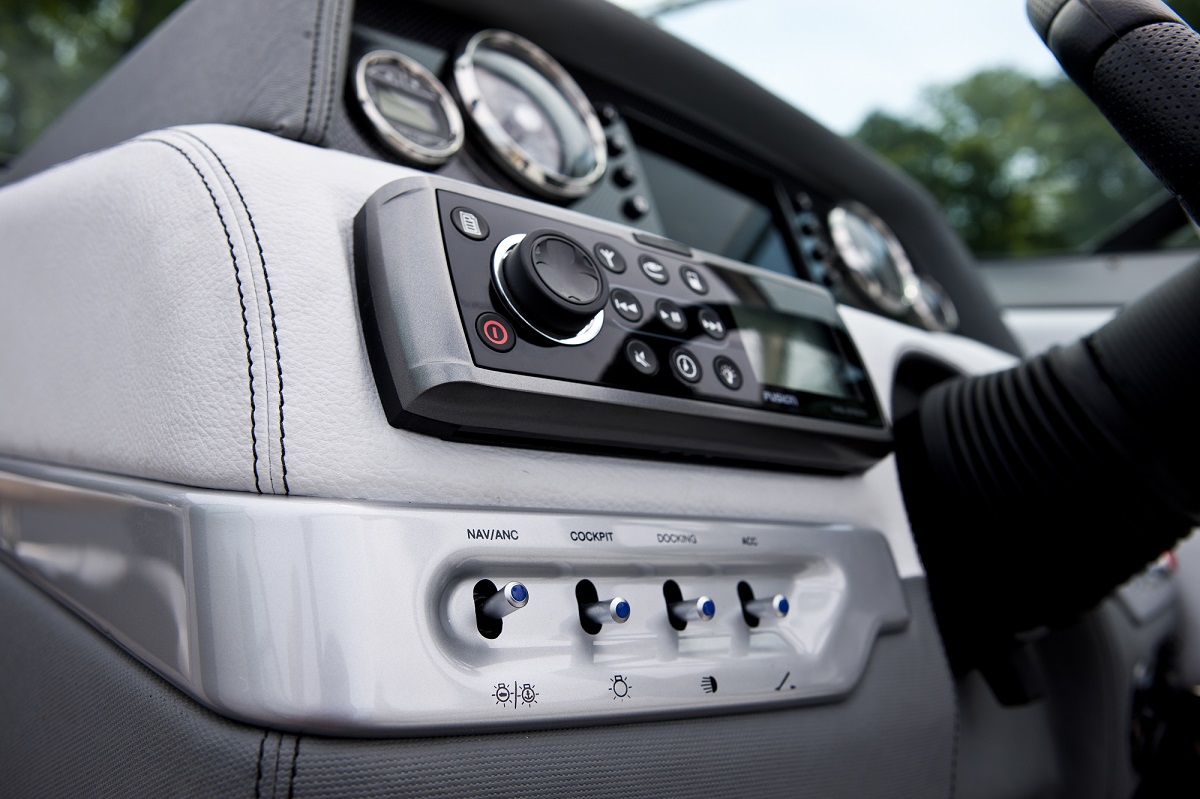
At the helm we find a vinyl wrapped dash to help reduce glare, Faria gauges, power steering and a 12-volt receptacle. The Fusion marine stereo is situated just to port of the steering wheel for uninterrupted access by captain and crew.
Moving forward to the bow there are two forward facing sun pads, complete with fold away armrests. As we found with the cockpit seating, these cushions also tilt up aided by gas struts to provide even more storage. Another nice touch is a dedicated anchor locker; something not always found on boats this size. An additional table mount is also located forward.
Sized for nimble handling and packed with innovation, the 2300 RX ably reflects the values that Paul and Carol Kuck based Regal Boats on many years ago - values that your family can enjoy for years to come.
Photos courtesy of Regal Boats, www.RegalBoats.com
Wednesday, June 26, 2013
For The Birds
It's nice to be surrounded by so much of nature when we are at our marina. I've noticed that the older I get (have gotten), the more I enjoy and appreciate nature. It has been our habit for the past three years to go to the boat on Thursday evenings to make a long weekend out of them all through the summer. Even if I have to run back to my work on Friday mornings, it's such a break to get to the boat & the sight and sounds of the birds are truly heartwarming.
Makes me feel good and I wanted to share a few photos of these pretty birds with you :-)
There are a large number of Ospreys in the area, with a nesting pair very close to the boat. I'm always fascinated by these majestic animals and stop to watch them in flight. Here's one circling overhead in search of a meal;
I was able to capture some video of this guy capturing his meal - a big fish;
We also have a few Great Blue Herons fishing and flying around. Interesting to watch these guys move along so s l o w l e y in search of their prey;
This one looks like the male, as he/it is larger than the one in the previous photo. Either that, or just older? Note the big goose in the distance. I think these guys have some sort of territory thing going on, with the Herons keeping to themselves;
Yet another batch of young gooses. Sure, they look cute when they're little, but grow up to be continuous poop machines :-(
And they tend to show up in numbers, so their poop droppings can really 'pile' up ;-) Hey! That's not even funny. . .
Monday, June 24, 2013
Choosing a Boat Anchor - eBay Guides
Unlike the hit song from the 70's, the last thing you want to do is 'Drift Away' after setting your anchor. A bit of planning and the right equipment will make setting the hook a secure experience.
Anchor Styles
A smaller boat needs a smaller anchor and a bigger boat needs a bigger anchor, right? This is not always the case, as size is an important consideration, but not the only one. Our experience has shown that the style of anchor has a greater bearing on its holding power than mere bulk.
When deciding on an appropriate anchor, take the following into consideration;
• Size of boat
• Bottom structure
• Sea and weather conditions
Considering at the various styles, think about where most of your anchoring will take place. Will it be a lazy afternoon at a quiet, inland bay or for days on end alongside a more exposed Caribbean island? Either way, take into account the bottom conditions to determine the corresponding style.
For small runabouts to larger cruisers, the most popular choices are;
• Claw or Bruce. Designed for mud bottom.
• Danforth. Best suited to a sand bottom, as the sharp flukes will dig in with tremendous holding power. Can also be used in a mud bottom, but may be more difficult to break free than a plow when retrieving.
• Delta or Plow. As the name implies, this anchor is designed to work its way into the bottom, much like a farmers plow. Good all-around anchor in many conditions, including weeds.
• Scoop Style (Spade, Rocna). These are relative newcomers to the scene and report fast setting with superior holding power. Down side is that they may be more difficult to retrieve and bring up lots of mud/weeds when set in those sea floor conditions.
We generally boat where the bottom is mud or sand and use a delta style anchor as our main, with a smaller Danforth as a backup or stern anchor. Our inflatable dingy has limited storage, making a folding grapnel style or mushroom anchor feasible choices. Although small and easy to store, these compact units are best suited to short term use only.
Anchor Construction
Most anchors are forged from steel with a galvanized coating to prevent rust, as they are relatively strong and reasonably priced. This mass production material is the most common used and we have never had an issue with this type of construction. Although more expensive, stainless steel anchors are another choice as they offer considerably more strength and can be polished to a high gloss shine. Think of it as having both ‘bling’ and ‘brawn’ for your bow ;-)
Rope or Chain?
Now that an anchor has been selected, we need to secure it to the boat. Use an anchor shackle to connect the anchor to the rode or chain. A piece of stainless steel locking wire should be run through the removable pin and tied around the shackle to avoid it turning out from vibration. No stainless wire on board? For a short term solution, a common zip tie can be used in a pinch, but is more susceptible to deterioration from use or UV damage.
The anchor rode (or line) is the next common element, produced from rope, chain or combination of both.
The advantages of an all rope anchor rode is its light weight and ability to stretch. The three common rope configurations are; traditional ‘twisted’ line, ‘single braid’ or ‘double braided’ line. Nylon is the preferable material, having the desirable characteristics of good elasticity and resistance to UV light. Another choice is Polyester, which is not quite as strong as nylon, but has better abrasion resistance and more UV resistant. The disadvantage of all rope is that it is considerably more susceptible to chafing and deterioration than chain.
Going with all chain will offer more weight, tending to improve the angle at which the anchor sets on the bottom. Chain is also preferable when anchoring in coral or rocky bottoms to reduce chafing that might otherwise occur on an all rope line. The disadvantage of going with all chain is that in very windy conditions the chain may go tight, with no slack or give. This could cause the anchor to break loose or damage deck fittings. Introducing a separate snubber line close to the deck would help relieve that strain.
Our choice matches that of many cruising boaters; a rope/chain combination, which gives us the benefits of both materials. Whichever way you go, be sure to have a ratio of at least ten times the length of rode to the depth of water you will be anchoring in - having even more on hand is advisable.
Windlass
The ‘First Mate’ on our boat loves the convenience of our mechanical windlass, which hoists the anchor up and down at the flick of a switch. Windlasses come with specific chain or rope sizes that they can work with, so match the rode to the unit you will be using.
It’s important to keep in mind that when using a windlass and the anchor has been set, it is imperative to take the load off of it, as it is not designed to bear the force generated by the boat’s weight. We have seen a fellow boater’s windlass that was damaged beyond repair when it was not properly tied off on a windy day. To avoid this yourself, relieve the windlass by attaching the rode directly to a cleat, or use a chain lock for an all chain rode. A mooring snubber will further reduce the strain on both the rode & boat.
Whatever your choice in hardware, once anchored it is vital to keep an eye on everything, checking periodically to make sure you are maintaining your anchorage. Changes in wind direction or speed, current or wave action can all affect the anchor’s hold, so be sure to be aware of these changes and adjust accordingly.
With a sound anchoring solution, you can relax to a ‘Peaceful, Easy Feeling’.